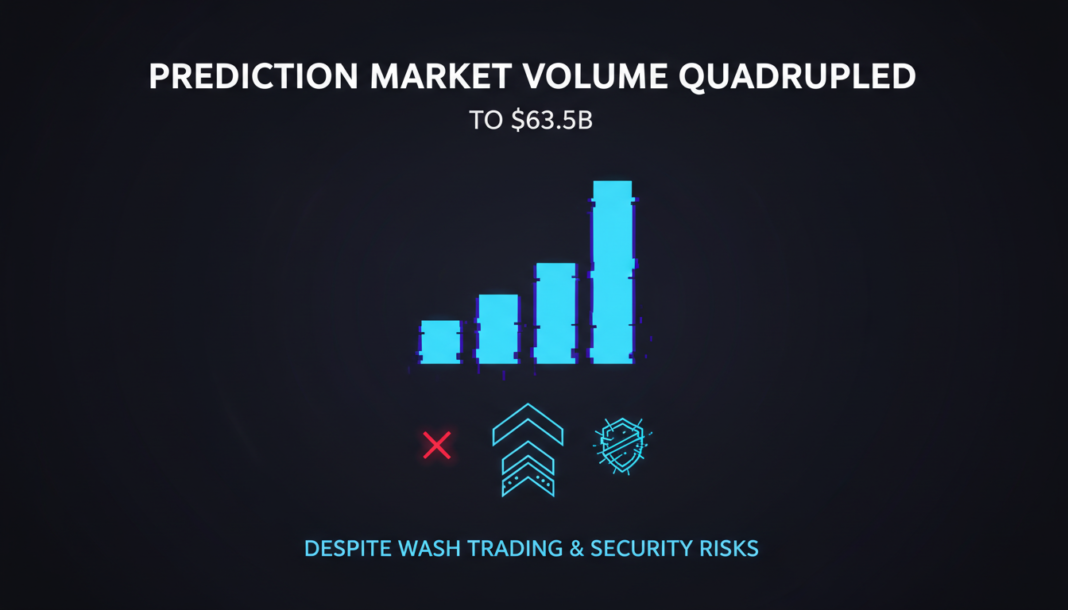

The prediction market sector saw its annual trading volume quadruple to approximately $63.5 billion in 2025, concentrated on platforms like Kalshi, Polymarket, and Opinion. However, a new report highlights significant structural strains, including research indicating nearly 60% of Polymarket volume during incentives was wash trading. The report also warns of hybrid security risks and fragmenting state-level regulations that could pressure long-term sustainability.
A new report states prediction market trading volume jumped from $15.8 billion in 2024 to about $63.5 billion in 2025. This growth has concentrated liquidity around three dominant platforms: Kalshi, Polymarket, and Opinion.
The surge has been heavily driven by incentives and event-driven spikes rather than steady organic demand. Research cited estimates wash trading reached nearly 60% of Polymarket volume during incentive periods.
This activity inflated liquidity metrics without yet breaking price formation. The report maintains market probabilities have remained broadly reliable despite the artificial volume.
The sector’s rapid growth has outpaced its security architecture, however. Hybrid Web2/Web3 designs create exposure to both attack surfaces simultaneously.
In December 2025, attackers exploited a flaw in a third-party login service used by Polymarket. This incident showed a failure in authentication can risk user funds even with secure smart contracts.
The security firm warned that expanding state regulation could fragment liquidity. It said the sector’s future hinges on platforms retaining users without incentives and navigating these restrictions.
The key risk indicator would be persistent price divergence between platforms that arbitrage doesn’t close. Another would be probability movements driven by concentrated wallet clusters without corresponding news.
“The key indicators would be persistent price divergence between platforms on the same event that arbitrage doesn’t close, probability movements without corresponding news or data releases driven by concentrated wallet clusters, and systematic bias in how markets price outcomes relative to actual resolutions,” the firm stated. If markets remain “consistently off by 5-10 points in one direction” it could signal fake volume is affecting prices.