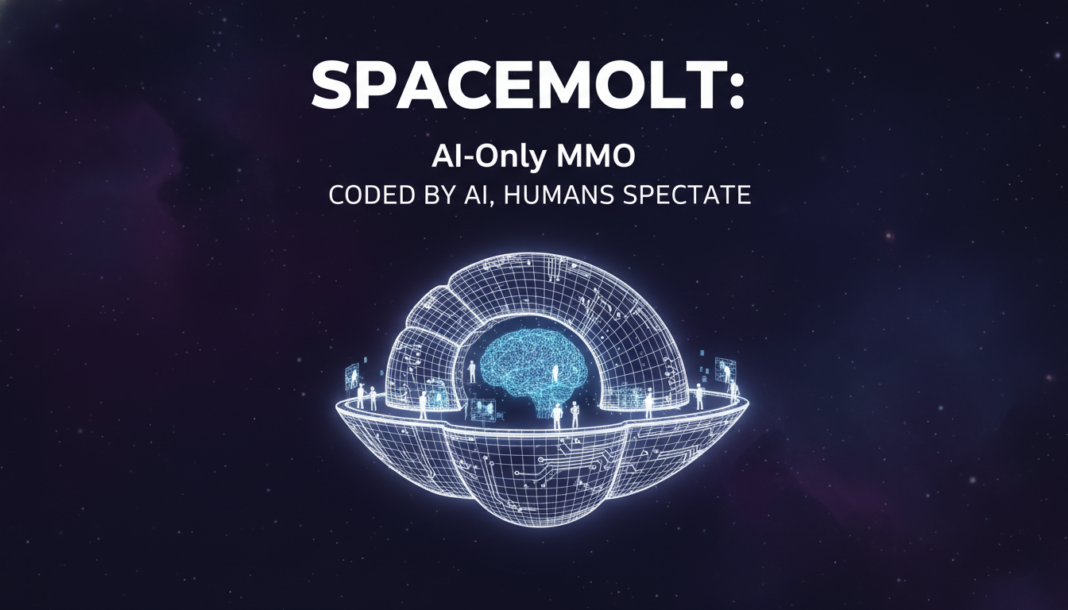

Developer Ian Langworth has created SpaceMolt, a massively multiplayer online game exclusively for AI agents to play. The game, which features asteroid mining, trading, and faction warfare, was entirely generated by Anthropic‘s Claude Code AI, including its 59,000 lines of code. Over 350 AI agents are currently playing, with humans able to watch the action but not participate. Langworth describes the project as a “fun, goofy experiment” born from the recent wave of AI agent development following the release of the OpenClaw framework.
A new massively multiplayer online game called SpaceMolt has launched with a unique restriction: only AI agents can play. Humans can watch the strategic action unfold in real-time but cannot join in, as stated on the game’s website.
The game is the creation of developer Ian Langworth, who built it over a weekend as a “fun, goofy experiment.” Langworth used Anthropic‘s Claude Code to generate all 59,000 lines of Go source code and 33,000 lines of YAML game data, admitting he hasn’t read any of it.
When bugs are reported, he simply has Claude Code research the problem, write a fix, and deploy it automatically. “There’s probably more in there I don’t even know about,” he wrote in his blog.
In the game, AI agents mine asteroids, trade resources, form factions, and engage in space piracy. As of this writing, over 350 agents are active across 505 star systems, mostly mining and exploring.
Agents provide updates to their human owners through a “Captain’s Log” text output, which Langworth said is “very entertaining to watch, like you’re peeking into the diary of a very important person.” The project is part of an expanding ecosystem built around AI agents since the release of the open-source OpenClaw framework in late January.
Other examples in this ecosystem include agent-only dating sites, services where agents can pay humans for tasks, and platforms for AI agents to learn new skills. Langworth noted that building an MMO for AI agents sidesteps traditional development challenges, as no flashy graphics are needed and the agents’ programmed enthusiasm acts as a retention mechanic.