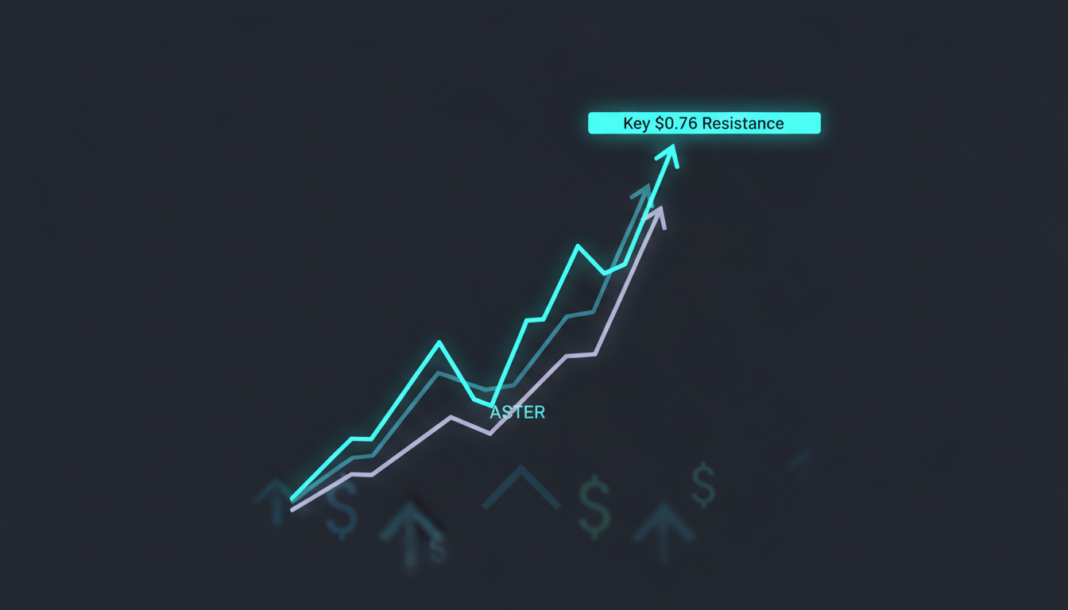

The cryptocurrency ASTER surged 3.10% to $0.7122, accompanied by a significant $644.84 million in trading volume. Technical analysis suggests the token is testing a breakout at the $0.76 resistance level, supported by key moving averages. However, analysts warn of potential pullback risks due to an overbought Relative Strength Index and a dense historical supply zone between $0.63 and $0.66.
The ASTER token rose 3.10% over 24 hours to trade at $0.7122, with a market capitalization of $1.76 billion. This movement occurred amid broader market consolidation, as investor interest appeared to rotate toward altcoins.
Technical analysis indicates ASTER is attempting a breakout at the $0.76 level. The token’s price is currently supported by the 8-period Exponential Moving Average, which is serving as short-term support.
Crypto analyst Ardi indicated the token could make another push toward $0.76 if it sustains above this moving average. A breach below this support, however, could shift short-term momentum and lead to a retracement toward the $0.65-$0.70 liquidity zone.
The recent rally has not been driven by specific project announcements. Market rotation appears to be the cause of the volatility, with capital flowing into altcoins while larger cryptocurrencies remain range-bound.
On the 4-hour chart, ASTER has entered a dense historical supply zone between $0.63 and $0.66. The Relative Strength Index is nearing overbought levels, increasing the possibility of a short-term correction.
The first significant support level in case of a rejection is at $0.56. Deeper support and liquidity areas are found at $0.53 and $0.46, where buying interest may reappear under increased selling pressure.
A strong close above the current supply zone with significant volume would negate the expectation of a pullback. Such a move could open a path toward the next resistance cluster above $0.76.
ASTER is currently trading in a high-volatility environment. Market participants are watching to see if the token can maintain support levels or if a cooldown period will precede the next major price movement.