

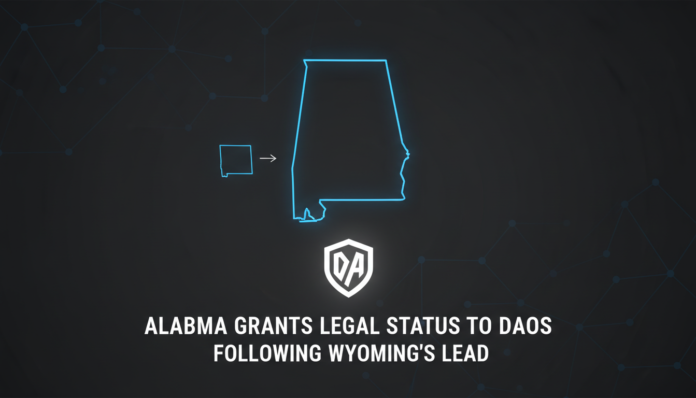
The US state of Alabama has granted legal status to decentralized autonomous organizations (DAOs) under the newly signed Decentralized Unincorporated Nonprofit Association (DUNA) Act. This makes Alabama the second jurisdiction after Wyoming to provide such legal recognition, offering DAOs the ability to operate as legal entities with limited liability protections for their members. The legislation is seen by advocates as a crucial step for enabling decentralized governance structures to scale in the real world.
Alabama has become the second U.S. state to grant decentralized autonomous organizations formal legal status. The state’s Governor, Kay Ivey, signed the Decentralized Unincorporated Nonprofit Association (DUNA) Act into law following its passage.
The bill, introduced by Republican Senator Lance Bell, provides DAOs with full legal entity standing. This allows them to own property, enter contracts, and sue or be sued while shielding individual members from personal liability.
“Decentralized governance is essential to crypto’s future—it’s one of the core constructs in market structure legislation,” said Miles Jennings, head of policy at a16z Crypto. He added the law gives decentralized communities “the certainty to build, govern, contract, and scale in the real world.”
To qualify, a DAO must have at least 100 members united for a common nonprofit purpose. Governance, including voting and proposals, can operate entirely through on-chain smart contracts and blockchain technology.
The move follows Wyoming, where a similar DUNA Act was signed in March 2024. Another bill in West Virginia, HB 5060, passed the state House and awaits the governor’s signature.
More than 13,000 DAOs exist globally, according to data from CoinLaw. Their collective treasury assets exceed $24.5 billion, with the average treasury valued at approximately $1.2 million.
