

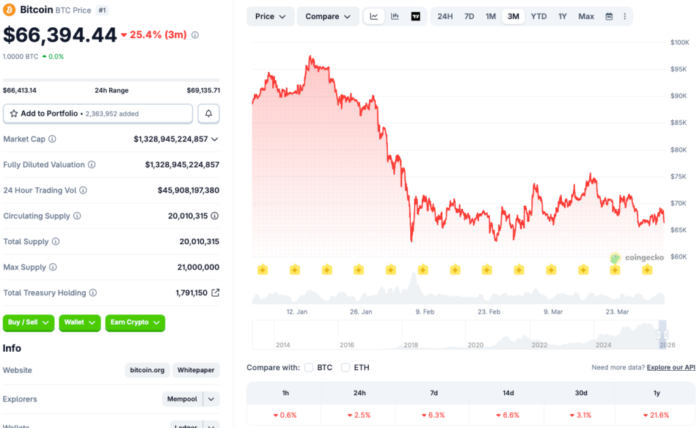
Bitcoin faced rejection at $69,000 on April 1, 2026, signaling a potential shift from previous higher resistance levels. The asset’s price has declined across multiple timeframes, with market analysts citing geopolitical tensions and new technological concerns as contributing factors to the recent correction.
Bitcoin failed to break above the $69,000 mark on April 1, a level notably lower than its prior resistance range between $72,000 and $73,000. This lower rejection point suggests the asset may be forming lower highs.
According to CoinGecko data, Bitcoin’s price fell by 2.5% over the last 24 hours. The weekly decline was 6.3%, while the 14-day and monthly charts showed drops of 6.6% and 3.1%, respectively. Market participants are questioning whether recent remarks by President Trump influenced the price action.
On Tuesday, Trump stated the US could exit the Iran campaign in 2-3 weeks, a potential de-escalation that coincided with Bitcoin’s climb toward $69,000. The following day, however, he reversed course by stating he wants ground forces to seize Iran’s uranium. This hint at re-escalation may have heightened investor anxiety.
Separately, a recent paper from Google raised concerns about cryptographic security. The report claims a future quantum computer could break a Bitcoin private key in just nine minutes. This is roughly one minute less than Bitcoin’s average block time.
The broader cryptocurrency market has faced substantial challenges in recent months. The ongoing US-Iran conflict has prompted investors to reduce exposure to risky assets like Bitcoin. Analysts suggest Bitcoin may oscillate between $70,000 and the $62,000-$64,000 range in coming weeks.
Furthermore, the Federal Reserve is unlikely to cut interest rates after its April meeting. Sustained higher interest rates could continue to pressure the cryptocurrency market by diverting investor capital.
