

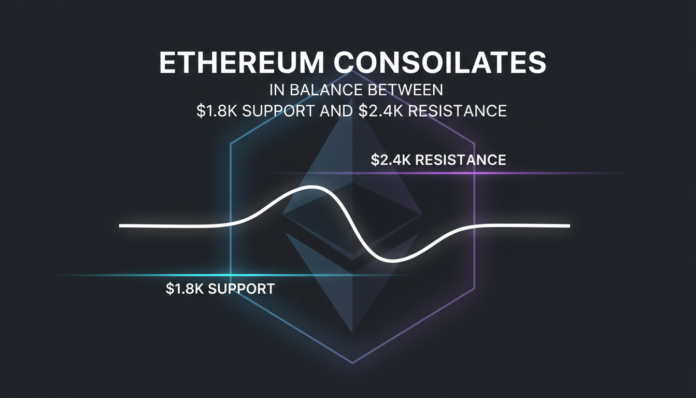
Ethereum’s price remains in a state of equilibrium, caught in a broad consolidation phase between $1.8K and $2.4K after a sharp correction earlier this year. Market volatility has compressed as neither buyers nor sellers establish control, creating range-trading conditions. Technical analysis on lower timeframes reveals a developing rising wedge pattern, which suggests weakening bullish momentum and increasing vulnerability to a downside move, particularly toward a key liquidity cluster at the $1.8K support level.
Ethereum’s price action continues to reflect a market in equilibrium, where neither buyers nor sellers have established decisive control. Following the sharp corrective phase earlier in the year, ETH has transitioned into a broad consolidation structure, with volatility compressing as the market searches for direction.
On the daily timeframe, Ethereum is clearly bounded within a well-defined range between the $1.8K support and the $2.4K resistance zone. The asset has repeatedly reacted to both boundaries, confirming them as key areas of supply and demand.
This indicates a balance between accumulation and distribution, where market participants are positioning rather than committing to a directional move. A decisive breakout from either side of this range will likely define the next major trend.
Zooming into the 4-hour timeframe, the structure reveals a rising wedge formation developing within the broader range. This pattern typically reflects weakening bullish momentum, as the price continues to make higher highs and higher lows, but with diminishing strength.
As the price approaches the apex of this formation, a breakout becomes increasingly likely. A downside break of the wedge would confirm the corrective nature of the structure and could trigger another leg lower, potentially driving price back toward the $1.8K support zone.
From a liquidity standpoint, the liquidation heatmap highlights a significant concentration of liquidity at and below the $1.8K level. This cluster represents a pool of resting liquidity that could act as a magnet for the price, particularly if bearish momentum begins to build.
In this context, a breakdown of the rising wedge on the lower timeframe could act as the trigger that drives Ethereum toward this liquidity pocket. Overall, Ethereum remains trapped in a broader consolidation phase, but the lower timeframe structure suggests increasing vulnerability to the downside.
