

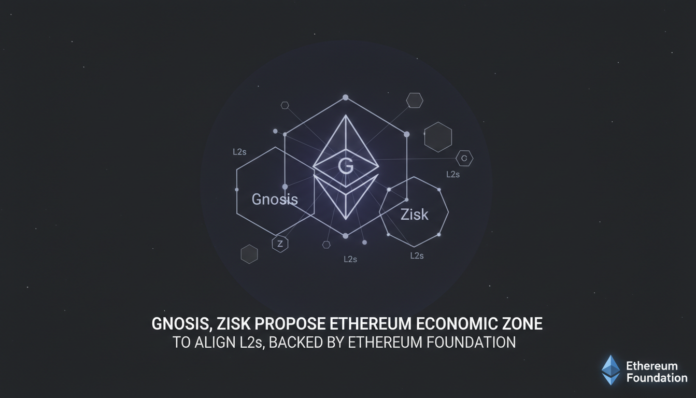
Gnosis and Zisk, with support from the Ethereum Foundation, have proposed the Ethereum Economic Zone (EEZ), a framework to create alignment between Ethereum’s mainnet and its layer-2 scaling networks. The initiative aims to address fragmentation by creating a shared execution environment where transactions can operate across multiple networks, defaulting to ETH for fees. This comes after recent criticism from Ethereum co-founder Vitalik Buterin regarding some layer-2 networks compromising on decentralization.
Gnosis and Zisk have proposed a framework for an “economic zone” to align infrastructure within Ethereum’s ecosystem. The initiative is co-funded by the Ethereum Foundation, indicating its interest in reshaping relationships between the mainnet and layer-2 alternatives.
The Ethereum Economic Zone is designed to let layer-2 networks operate across a shared environment to prevent siloed user activity. “Every new L2 is a silo that makes it harder to seamlessly extend and drive value back to the Ethereum mainnet,” said Gnosis co-founder Freisderike Ernst, adding “The EEZ is designed to do the opposite.” For networks in the EEZ, transactions will be executed across various layer-2s and Ethereum’s mainnet itself.
This development follows recent remarks from Ethereum co-founder Vitalik Buterin, who called for change last month by arguing projects compromising on decentralization aren’t true ecosystem extensions. Many current layer-2 networks use centralized sequencers, a design that has drawn growing community criticism for creating gatekeepers and capturing fee revenue.
The framework will use zero-knowledge proofs, a form of cryptography. Technical specifications for the EEZ are expected to be shared in the coming weeks, and an EEZ Alliance has been unveiled including Aave and XStocks.
