

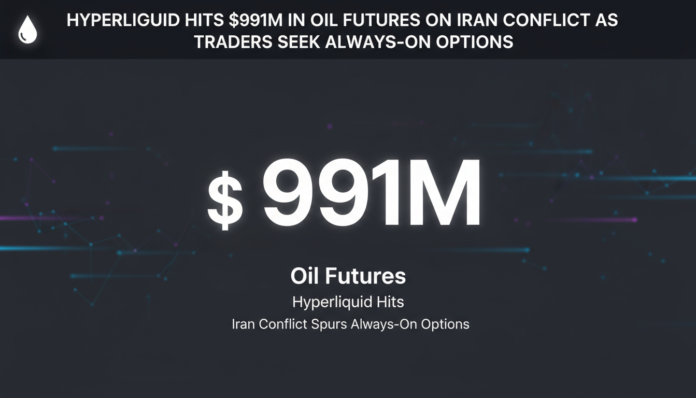
Crypto traders are increasingly using the decentralized exchange Hyperliquid to speculate on oil prices through perpetual futures contracts. Over a recent 24-hour period, oil-linked perpetuals on the platform saw roughly $991 million in trading volume, vastly exceeding the approximately $75,000 in similar activity on Coinbase. The surge coincides with geopolitical tensions involving Iran, which briefly pushed Brent crude prices to about $119.50 a barrel. This activity highlights how always-on crypto markets are absorbing trading tied to global macro shocks and has contributed to a rise in the price of Hyperliquid’s native HYPE token.
Crypto traders are increasingly using the DeFi derivatives platform Hyperliquid to speculate on oil prices. This is a sign that always-on crypto markets are beginning to absorb trading tied to global macro shocks.
Oil-linked perpetual futures on Hyperliquid processed roughly $991 million in trading volume over the past 24 hours, according to data shared on X. Comparable contracts recorded about $75,000 in volume on Coinbase over the same period.
The disparity shows how liquidity for synthetic commodity exposure is clustering on crypto-native derivatives venues. Order-book data suggests participation from professional liquidity providers alongside retail traders.
Brent crude briefly surged to about $119.50 a barrel earlier this week amid fears the Iran conflict could disrupt shipments through the Strait of Hormuz. Prices later pulled back after President Donald Trump suggested the war might soon de-escalate.
By Wednesday evening, Brent crude was hovering around $90–$92 a barrel. Markets continued to digest developments and the prospect of emergency oil stockpile releases.
The trading activity has helped push the price of the platform’s native token, HYPE, above $32. It rose a further 6% on the day to $36.33, according to CoinGecko data.
Hyperliquid lets traders take leveraged positions through perpetual futures contracts collateralized by stablecoins. This allows speculation without accessing regulated commodity futures venues like the CME Group.
For Hyperliquid’s native token, HYPE, trading tied to macro volatility can have direct financial implications. The protocol directs a portion of trading fees toward token buybacks, linking spikes in derivatives activity to potential demand for the asset.

