

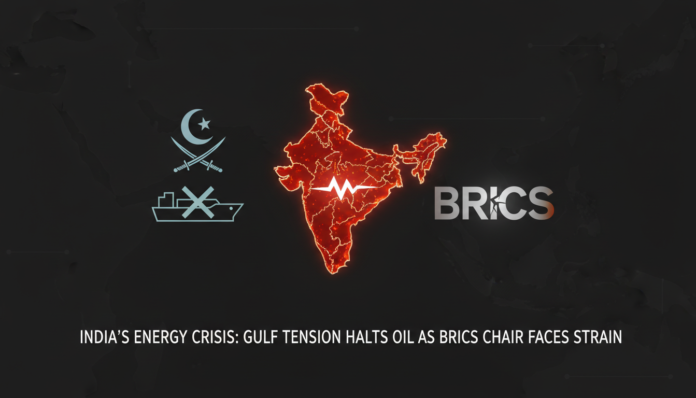
Geopolitical tensions between India and Gulf nations have severely disrupted global oil flows, with the Strait of Hormuz operating at a fraction of its normal capacity. This crisis has forced India, which relies heavily on Gulf imports, to revert to purchasing Russian crude. The strain extends beyond energy, impacting billions in worker remittances and complicating India’s role as the current chair of the BRICS alliance.
The ongoing India-Gulf tensions are stress-testing the country’s long-discussed energy security vulnerabilities. Brent crude has crossed $80 per barrel as the Strait of Hormuz, a critical passage for roughly 40% to 50% of India’s oil imports, has ground to a near halt. On a recent day, only three tankers carrying approximately 2.8 million barrels managed to cross against a typical daily average of nearly 20 million barrels.
QatarEnergy declared force majeure after a drone strike hit Ras Laffan, cutting off a supplier that accounted for close to 39% of India’s LNG imports in 2024. Go Katayama, principal insight analyst at Kpler, noted that more than half of India’s LNG imports are Gulf-linked and a significant share is Brent-indexed. He stated, “That creates a dual physical and financial shock.”
India is now forced to pivot its oil sourcing strategy rapidly. Its imports of Russian crude had dropped significantly, partly driven by a US-India trade deal commitment. According to Bloomberg and ship-tracking data from Kpler and Vortexa, at least three tankers carrying Russian oil have already diverted to Indian ports. Ellen Wald, president of Transversal Consulting, told CNBC, “It is bad timing for India.”
The Gulf crisis impact spreads well beyond fuel, touching vital economic flows. Approximately 9 to 10 million Indians work across the Gulf, sending home roughly 38% of India’s total remittances—an annual inflow of $49 to $52 billion. The tensions also strain India’s BRICS trade agenda and related projects like the India-Middle East-Europe Economic Corridor.
Prime Minister Modi’s recent diplomatic stance has further complicated the situation. After visiting Israel, he said, “India stands with Israel, firmly, with full conviction.” A former Indian ambassador assessed that the visit was wrongly timed and has completely ripped India off its neutrality. The ambassador said, “We are seen in the Israeli corner.”

