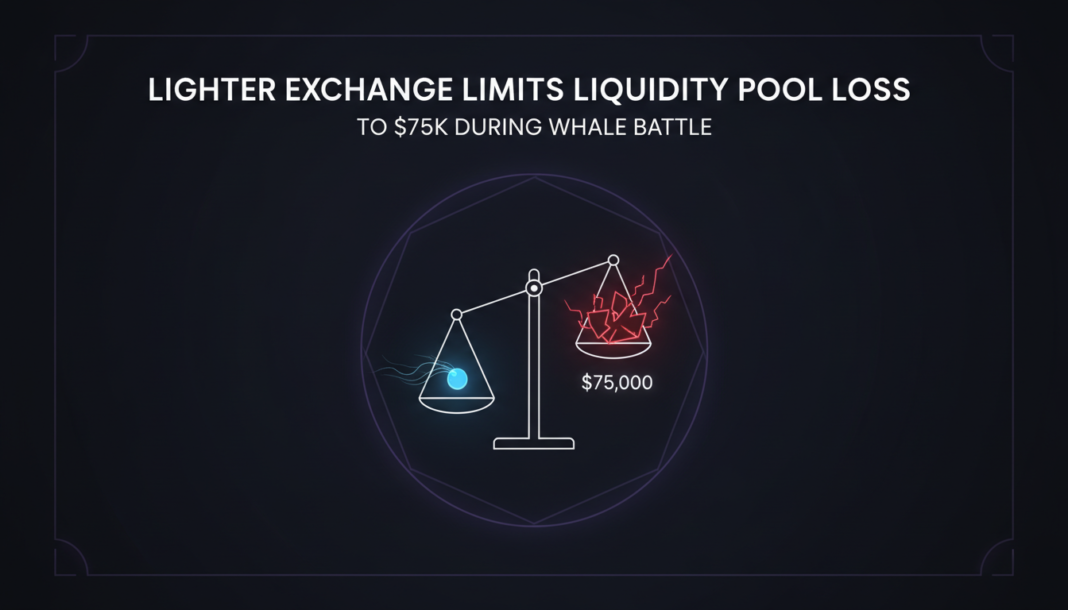

Decentralized exchange Lighter reported its upgraded liquidity pool system successfully limited auto-deleveraging losses to a pre-determined threshold. The platform stated its new LLP Strategies faced a first stress test when approximately 600 traders reversed a whale’s large long position in ARC perpetuals, resulting in an $8.2 million loss for the whale. Lighter’s system capped losses for liquidity providers at $75,000 during the $50 million market event, which contributed to a sharp price decline for the ARC token.
Lighter, a decentralized crypto exchange, announced its upgraded liquidity pool system successfully resisted a $50 million ARC perpetual long squeeze attempt. The event occurred after around 600 traders reversed a whale’s position, resulting in an $8.2 million loss for the large trader.
This episode tested Lighter’s newly launched LLP Strategies, capping the downside risk for liquidity providers at just $75,000. The platform had announced changes to its LLP infrastructure on February 17, splitting liquidity into separate strategies for different market types.
Risk and auto-deleveraging are now handled at the strategy level rather than across the entire pool. Lighter called the February 26 event its “first battle test” for this new structure.
ARC perp trading was assigned to a high-risk strategy with about $75,000 in allocated USDC. Lighter stated only that portion of LLP deposits could be exposed if auto-deleveraging occurred.
As ARC’s price fell, the large long position was liquidated on the order book for roughly $2 million. Further downside depleted the specific strategy, triggering an ADL event and the capped loss for liquidity providers.
The unwind contributed to a flash crash for the ARC token, with data showing it slid from around $0.031 to $0.025 before recovering. At the time of writing, ARC was down over 9% in 24 hours and nearly 59% across seven days.
Crypto commentator Simon Dedic noted that ARC’s value had dipped overnight by about 80% on volumes approaching $400 million. Dedic pointed out that before dumping, the token had been “massively outperforming” despite a weak market.