

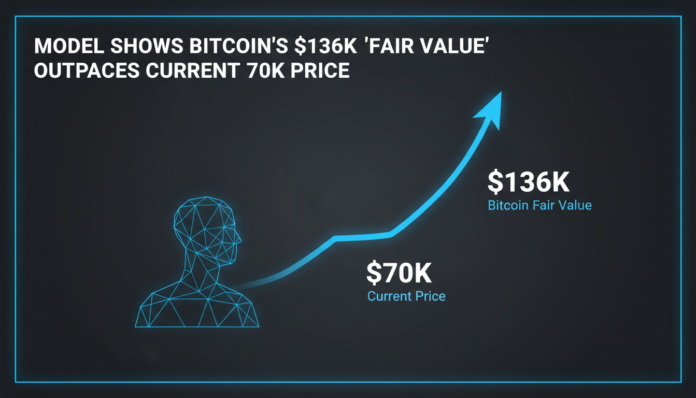
Bitcoin is trading at a significant discount compared to global liquidity trends, according to analysts. While global money supply has increased, tighter U.S. monetary policy and rising energy costs are limiting capital flows into risk assets like cryptocurrency.
Bitcoin is trading at a steep discount to global liquidity trends, according to new analysis from CF Benchmarks. Global M2 money supply has risen about 12% since mid-2025, while Bitcoin has fallen roughly 35% over the same period. One model cited in its report implies a “fair value” of about $136,000, compared with Bitcoin’s current price near $70,000.
Analysts say the missing link is U.S. monetary policy. The Federal Reserve has reduced its balance sheet and maintains elevated interest rates, keeping financial conditions tight even as liquidity grows elsewhere. This backdrop has limited capital flows into markets, leaving Bitcoin more closely tied to real rates and broader risk sentiment.
At the same time, rising energy prices are adding pressure to household finances. Economists estimate that an 81-cent increase in U.S. gasoline prices since late February could cost households roughly $740 over the year, potentially offsetting much of the boost from larger tax refunds projected by the White House. Markets have also focused on disruptions to the Strait of Hormuz and the resulting inflationary risks, with oil topping $100 a barrel.
The combination risks dampening discretionary spending and reducing the pool of capital available for investment in higher-risk assets, including cryptocurrencies. Still, most experts argue that global economic growth could accelerate again if financial conditions ease and the conflict in the Middle East is contained.
Gabe Selby, Head of Research at CF Benchmarks, stated, “The key takeaway from more than a decade of data is that divergences between M2 and Bitcoin have historically been temporary.” He added that ongoing buying from the U.S.-listed spot Bitcoin ETFs and corporate treasuries represents a source of structural demand that did not exist in prior cycles. Past cycles suggest Bitcoin tends to catch up with liquidity trends over a multi-quarter horizon, particularly when the Fed shifts toward rate cuts.
