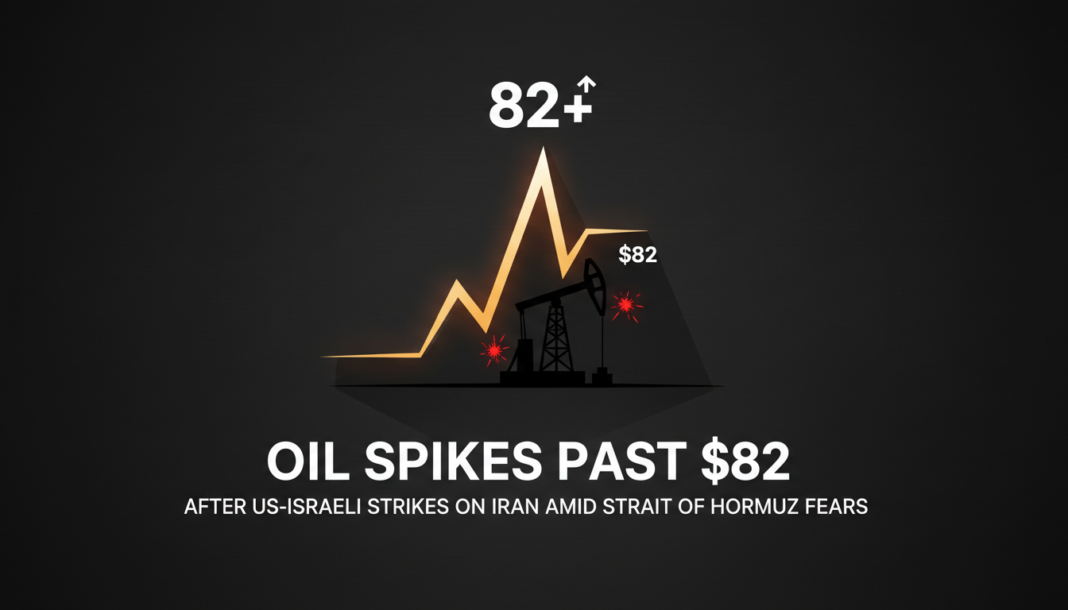

Brent crude oil prices surged above $82 a barrel following U.S. and Israeli strikes on Iran, reflecting heightened market fears over Middle East tensions and the critical Strait of Hormuz supply route. The price spike was sharp but moderated, with analysts noting the reaction was within expected ranges for such a geopolitical event. The immediate impact on global oil flows was significant, with tanker traffic through the strait plummeting from 65 vessels to just six.
Crude oil prices spiked sharply after the United States and Israel launched strikes on Iran, sending Brent crude briefly above $82 a barrel. The move reflected growing fears over access to the Strait of Hormuz, through which roughly one-fifth of the world’s daily oil flows.
Prices opened around $72 for U.S. crude and hit $82 for Brent before pulling back below $78. The Brent crude oil price had settled just above $73 on Friday, meaning the gap was steep.
Tanker traffic through the Strait of Hormuz dropped to just six vessels on Sunday, from 65 on Friday, according to S&P Global Energy. Verified videos showed a tanker ablaze near Oman.
Amy Myers Jaffe, Director of the Energy, Climate Justice and Sustainability Lab at NYU, stated: “The biggest question is what, if any, oil installations get damaged. If the answer to that is none, my opinion is the price of oil will come back down.”
The fallout is already being felt at the pump, with national gas prices averaging $2.98 a gallon. Tom Kloza, a veteran oil analyst and advisor to Gulf Oil, warned that could change fast.
Kloza stated: “Clearly, there’s a whiff of panic there. They’re afraid that they’re going to get hit with massive price increases. It’s just, where do we stop? Prior to Friday night, I would have said that we would stop at $3.25. Now it’s kind of open ended.”
Jason Bordoff, Founding Director of the Center on Global Energy Policy at Columbia University, stated: “Americans will see some impact at the gasoline pump. But even with a massive strike on Iran that killed the leader of the country, at this point we’re still talking about oil prices that are well within historical norms.”
OPEC+ announced a modest output increase for April, but analysts do not expect it to keep crude oil prices in check if the conflict drags on.