

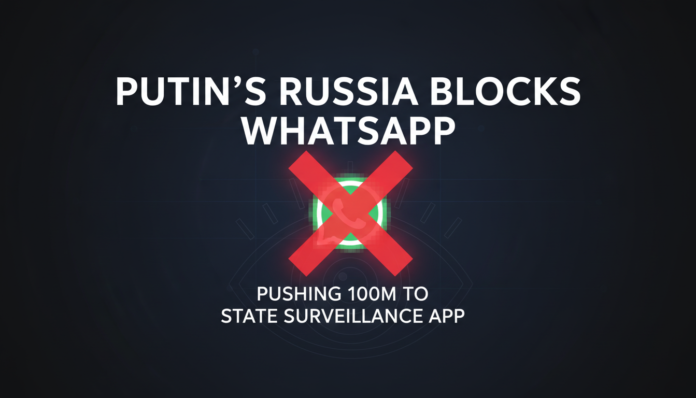
Russia has moved to fully block WhatsApp, attempting to redirect its over 100 million users to a state-controlled messaging platform. Kremlin spokesman Dmitry Peskov stated the service’s return is contingent on dialogue and compliance with local law, while digital rights advocates warn the state’s “Max” app is a tool for surveillance and political censorship.
Russia moved to fully block Meta-owned WhatsApp on Thursday. The company stated the action is an attempt to funnel over 100 million Russian users toward a state-owned application that lacks encryption.
Roskomnadzor, Russia’s communications regulator, simultaneously moved to restrict Telegram, stating it will continue limitations until the app complies with local law. Kremlin spokesman Dmitry Peskov told state media that restoration of WhatsApp is “possible subject to compliance with Russian law and a willingness to engage in dialogue,” but added “if the corporation continues to take the same uncompromising stance … then there’s no chance.”
Digital rights advocates describe this as a familiar pattern of replacing foreign platforms with domestic alternatives that enable state control. “Yeah, we’ve seen this before. China, Iran, and now Russia. Same pattern every time — block the foreign platforms, spin up a domestic app, call it ‘sovereignty’ or ‘security,'” said Shady El Damaty, a digital rights advocate.
Russia has been promoting Max, a state-developed “super app” modeled on China’s WeChat, which combines messaging with government services. The app has been mandated for pre-installation on new devices and is required for public sector employees, teachers, and students. El Damaty warned such platforms become a control point, leading to default surveillance.
Telegram co-founder Pavel Durov responded to the pressure, stating on social media that “Russia is restricting access to Telegram to force its citizens onto a state-controlled app built for surveillance and political censorship.” He cited Iran’s failed attempt to ban Telegram eight years ago as evidence that such strategies often backfire, with users preferring private platforms.
