

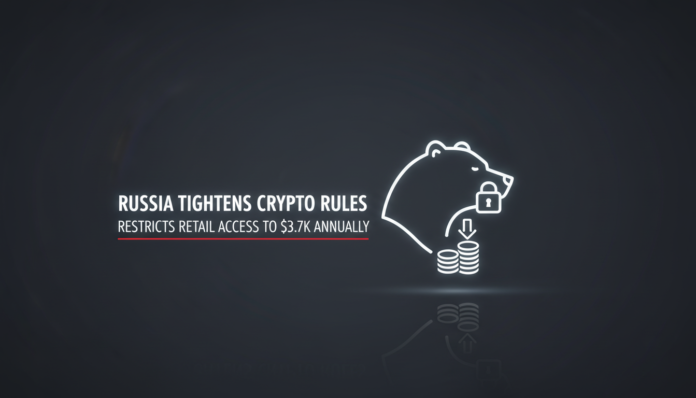
Russia’s government has approved draft legislation to legalize and tightly control domestic cryptocurrency trading. The new framework would require all transactions to pass through licensed intermediaries, sharply limit retail investor access, and introduce significant licensing requirements for crypto operators. While aiming to formalize the sector, critics argue the rules could push activity into unregulated channels.
Russia’s government has approved a package of draft bills to legalize the circulation of digital currencies. The Finance Ministry stated that transactions involving digital currency without regulated intermediaries will be prohibited under the new framework.
The rules introduce significant limits for retail investors, who must pass a test to participate. Retail purchases are capped at $3,700 worth of the “most liquid digital currencies” per year through a single intermediary.
Residents will still be allowed to buy crypto using foreign accounts, provided those transactions are reported. The package establishes a licensing regime for entities involved in crypto operations, including exchanges and custodial services.
Banks and brokers will be permitted to participate under specific regulatory requirements. The framework also provides for administrative liability for violations by organizations engaged in exchange activity.
Critics say the rules could backfire on the government’s oversight goals. Exved founder Sergey Mendeleev argued the move pushes crypto into a securities market framework while other nations are liberalizing access.
“In the end, it will be like with casinos — people won’t play less, but everything will move out of state control into online and underground venues,” Mendeleev said. The approved package includes bills on digital currencies and digital rights, alongside amendments to existing legislation.
