

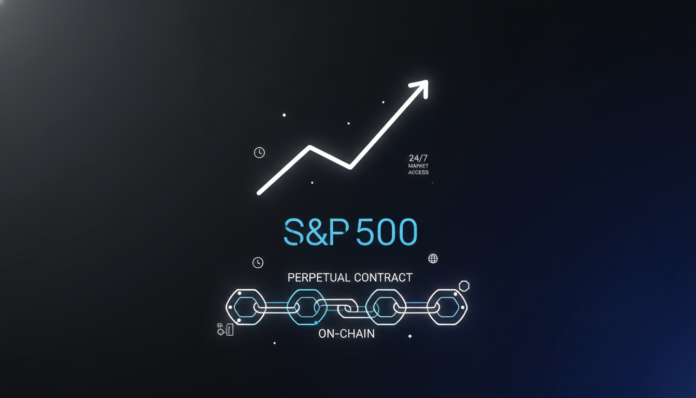
S&P Dow Jones Indices and trade.xyz have collaborated to launch a perpetual contract tracking the S&P 500, exclusively on Hyperliquid. This on-chain derivatives product provides 24/7, year-round access to the traditional equity benchmark, a shift from standard market hours. Hyperliquid’s total value locked, a measure of platform liquidity, was approximately $4.7 billion as of mid-March, underpinning the launch.
A new on-chain derivatives product tied to the S&P 500 has launched, marking a step toward round-the-clock access to traditional financial benchmarks. The product is a perpetual contract tracking the S&P 500, available exclusively on Hyperliquid.
Unlike traditional equity markets, which operate within fixed trading hours, the new contract offers continuous exposure to the S&P 500, trading 24/7/365. This shift reflects a broader trend in crypto markets toward always-on financial infrastructure.
The product was developed through a collaboration between S&P Dow Jones Indices and trade.xyz. It uses official index data from S&P Dow Jones Indices to maintain pricing alignment while operating in a crypto-native trading environment.
The newly launched perpetual contract represents a shift in how S&P 500 exposure can be accessed. Instead of relying on intermediaries and market hours, users can now gain exposure through an on-chain derivatives platform.
Unlike traditional futures contracts, perpetual contracts do not expire. They use a funding mechanism to keep prices aligned with the underlying reference, in this case the S&P 500 index.
This structure allows traders to maintain positions continuously without needing to roll contracts. However, the product remains a derivative instrument, not direct ownership of S&P 500 stocks or a regulated equity product.
Data from DeFiLlama showed that Hyperliquid’s total value locked stood at approximately $4.7 billion as of mid-March. This highlights the platform’s rapid expansion over the past year.
The protocol has grown from minimal liquidity to a multi-billion-dollar scale. This level of liquidity provides the foundation to support more complex derivatives tied to traditional financial benchmarks.
