

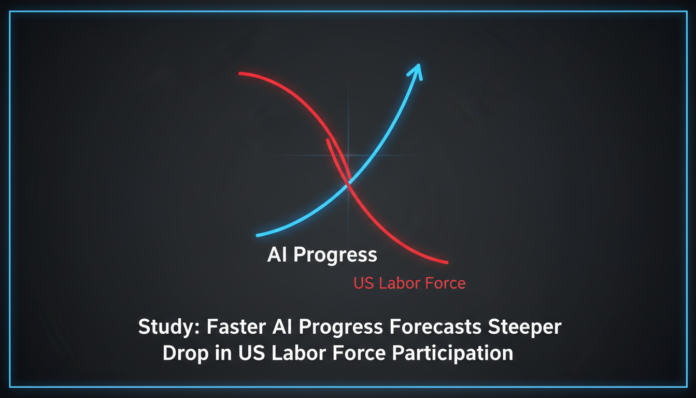
A major multi-university study finds that faster AI progress directly correlates with fewer people working, cracking the long-held “augment, not replace” consensus. Economists forecast that under a rapid AI adoption scenario, the U.S. labor force participation rate could drop from 62% to 54% by 2050, with roughly 10 million jobs lost directly to AI. While GDP is projected to grow strongly, wealth inequality could surge, with the top 10% of households potentially holding 80% of total wealth.
A new paper from researchers at the Federal Reserve Bank of Chicago, the Forecasting Research Institute, Yale, Stanford, and the University of Pennsylvania surveyed experts on AI’s economic impact. All groups agreed that faster AI progress means lower labor force participation, a polite way to say *”fewer people working.”*
Under a “rapid” scenario where AI surpasses human performance by 2030, economists forecast a significant drop in labor participation by 2050. About half of that drop would be directly attributable to AI rather than demographics.
The same rapid scenario projects annual GDP growth hitting 3.5% by 2045-2049, with AI experts forecasting 5.3% growth. The researchers note this could lead to tremendous aggregate wealth creation concentrated at the top.
The wealthiest 10% of households could hold 80% of total wealth by 2050 under rapid AI adoption. This level of inequality would be higher than pre-World War II levels.
The expert disagreement is now less about whether powerful AI will arrive and more about the economic consequences. The new question is whether AI automates the task of inventing new tasks, unlike previous technologies.
Current aggregate employment data remains mostly stable, with a late 2025 study finding no mass unemployment signal. However, research cited in the new paper documents a 13% relative employment drop among young workers in AI-exposed occupations.
On policy, economists largely favor targeted retraining programs but reject job guarantees and are cool to universal basic income. The paper’s authors note optimal policy depends heavily on which AI scenario ultimately plays out.
Anthropic CEO Dario Amodei has warned the disruption is accelerating faster than most expect. The study’s rapid scenario effectively validates that framing of imminent economic change.
