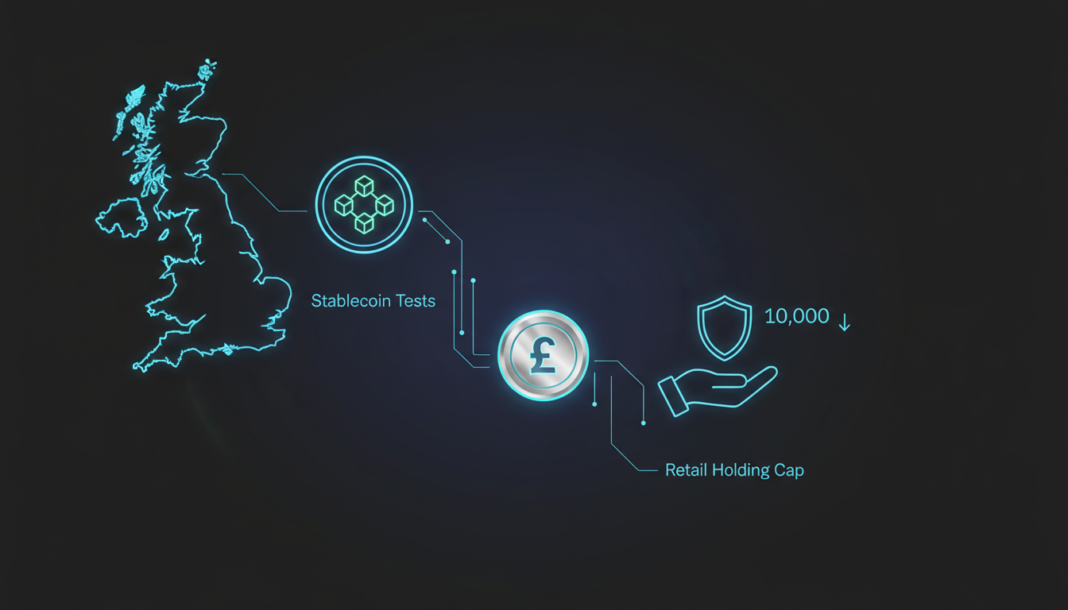

The UK Financial Conduct Authority has initiated live trials for sterling-based stablecoins within a regulatory sandbox, allowing firms like Revolut and Monee Financial Technologies to test applications. Concurrently, the Bank of England has proposed strict holding limits of approximately $25,000 for individuals and $12.5 million for companies per systemic stablecoin, aiming to contain risk while the technology is assessed.
UK regulators are advancing a dual-track strategy for stablecoins, combining live experimentation with proposed safeguards. As stated by the Financial Conduct Authority, a sandbox program has selected four firms to begin testing use cases like payments and settlement this quarter.
The testing will be conducted under tightly controlled conditions without public rollouts. It notably excludes major high-street banks, reflecting ongoing caution among large UK lenders toward the technology.
Running parallel to this is a separate proposal from the Bank of England to impose caps on user holdings. Individuals would be allowed up to about $25,000 per systemic stablecoin, while companies could hold up to approximately $12.5 million.
These measures are intended as temporary safeguards against risks like deposit flight from traditional banks. The caps would apply only to stablecoins deemed systemic and are designed to be revisited as the market matures.
Taken together, these initiatives reflect a regulatory strategy that prioritizes learning and containment over rapid scale. Policymakers acknowledge stablecoins could improve efficiency but remain wary of their potential to blur lines with bank deposits.
The industry context shows pound- and euro-denominated stablecoins account for a marginal fraction of global circulation. Against that backdrop, the sandbox aims to determine whether sterling stablecoins can operate safely within the existing financial system.