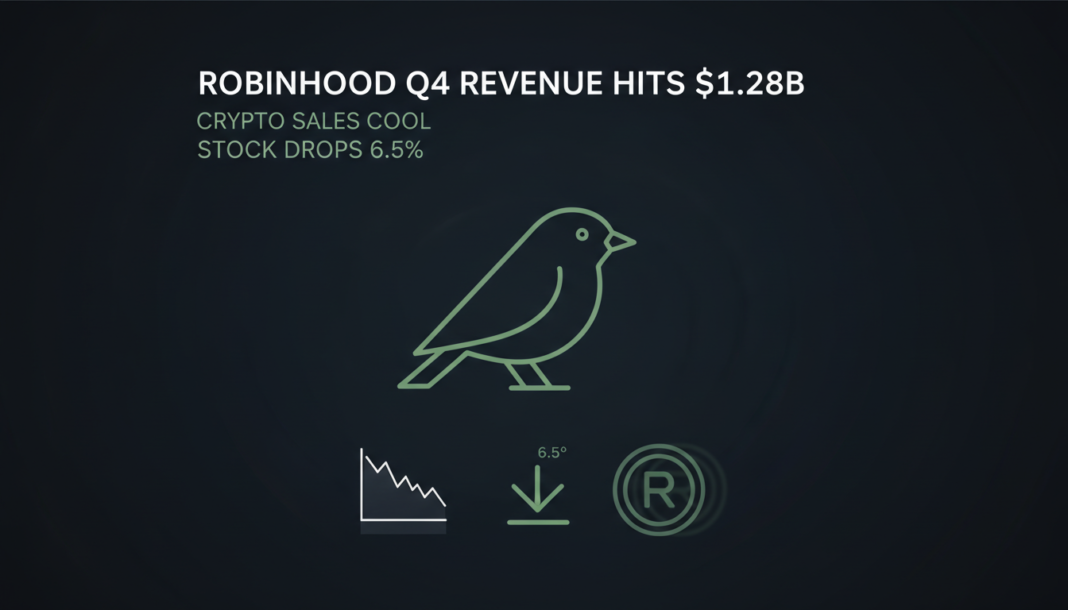

Robinhood missed Wall Street earnings expectations for its fourth quarter, posting $1.28 billion in revenue against forecasts of $1.35 billion. The retail brokerage’s revenue from crypto transactions fell to $221 million, a decline linked to a broader market downturn. CEO Vlad Tenev stated the company’s vision remains building a “financial superapp,” but the stock price dropped over 6% in after-hours trading following the report.
Robinhood disclosed $1.28 billion in fourth-quarter revenue, which was a 27% year-over-year increase but below analysts’ expectations. Net income fell 33% year-over-year to $605 million, also missing Wall Street’s earnings per share forecast.
Revenue from crypto transactions fell sequentially to $221 million, marking a 38% decrease compared to the same period last year. Bitcoin‘s price fell 23% in the quarter, according to CoinGecko, indicating the cooldown coincided with plunging crypto markets.
The company’s transaction-based income, which makes up a bulk of its sales, came in at $776 million for the quarter. However, Robinhood‘s stock price dropped 6.5% in after-hours trading to $80 according to Yahoo Finance, continuing a slide from its October high.
Prediction markets powered by Kalshi served as a bright spot, with traders exchanging 12 billion event contracts on the platform in 2025. CEO Vlad Tenev has described prediction markets as the firm’s “fastest-growing product line by revenue ever.”
The company recently expanded its prediction-market offering to allow parlay-like bets, widely available in the U.S. Analysts at investment bank Compass Point had underscored professional sports as an emerging tailwind for this segment. Robinhood charges a one-cent fee on transactions involving these markets.
Separately, Robinhood continues to develop its own Ethereum layer-2 scaling network called Robinhood Chain. The network currently supports “stock tokens” for customers in Europe, providing synthetic exposure to U.S. equities.