

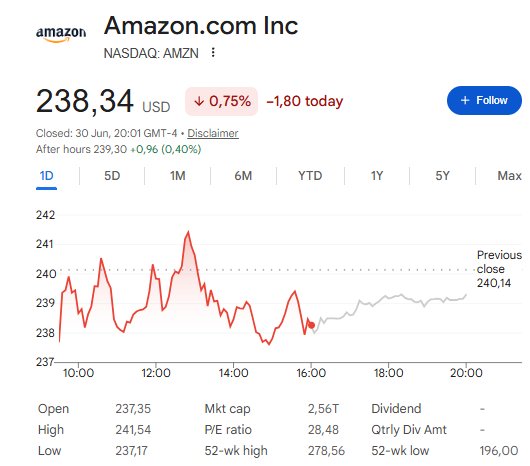
Amazon stock closed at $238.34 on June 30, near the lower end of its 52-week range. Despite this, analyst sentiment remains overwhelmingly bullish, with approximately 95% of 41 analysts rating it a Buy or Strong Buy and an average price target near $312.99. The decision to sell is framed as a personal portfolio choice rather than a reaction to company fundamentals.
Amazon Inc. stock closed at $238.34 on June 30, trading near the lower end of its 52-week range of $196.00 to $278.56. The Amazon stock outlook remains bullish heading into earnings, according to market analysis.
Out of 41 analysts covering the stock, around 95% rate it a Buy or a Strong Buy. Their average price target is close to $312.99, as reported by financial data.
Amazon carries a market capitalization of approximately $2.56 trillion. Its AWS cloud division recently posted close to 28% revenue growth, while advertising has also maintained growth above 20% annually.
Evercore ISI analyst Mark Mahaney sees close to 50% upside in the stock. He stated, “At the end of the day, Amazon remains a high quality compounder (25% EPS compound annual growth rate), with solid double-digit revenue growth, expanding operating margins, and free cash flow likely to inflect up materially in a 24-month timeframe.”
Some investors consider trimming shares for portfolio management rather than selling completely. This approach locks in some gains while maintaining long-term exposure to a widely recommended stock.
AWS raised prices on its reserved GPU capacity for a third straight quarter recently. Wells Fargo’s Ken Gawrelski, who maintains a $312 price target, reads this as a sign that compute demand is outpacing supply.
If an investor decides to sell, they can use a market order for immediate execution or a limit order for price control. The process involves logging into a brokerage platform, finding the AMZN holding, and executing the sell order.
None of the 41 tracked analysts have issued a Sell or Strong Sell rating on Amazon stock. The decision to sell ultimately depends on an investor’s individual portfolio exposure and goals.
