

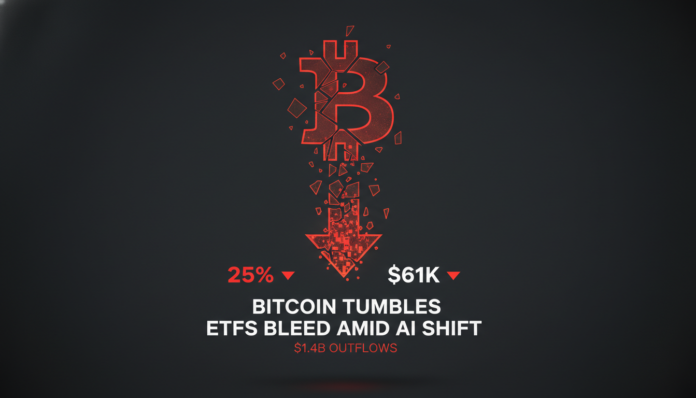
Bitcoin’s price has declined approximately 25% in under a month, falling from above $82,000 to near $60,000. The drop is attributed to significant investor exodus from U.S. spot ETFs, with over $1.4 billion in outflows recently, and the movement of about 54,000 BTC worth over $3.3 billion onto exchanges. Macro tensions from renewed U.S.-Iran conflict and capital rotation toward AI sectors are also cited as contributing factors, while analysts offer mixed views on potential future price levels.
Bitcoin is testing the $60,000 support level after a sharp decline from recent highs above $82,000. Data reveals a sustained exit by investors from U.S. spot Bitcoin ETFs, with net outflows exceeding $1.4 billion in the current week.
SoSoValue data shows these funds have seen net withdrawals for 13 consecutive days. This marks a stark reversal from the heavy inflows witnessed in mid-May.
On-chain analyst Ali Martinez reported roughly 54,000 BTC, valued at approximately $3.35 billion, was moved to trading platforms recently. This increased supply is seen as applying significant short-term selling pressure.
Broader market factors include renewed military conflict between the U.S. and Iran, which now involves other regional nations. Historical patterns show risk assets like Bitcoin often react negatively to escalating geopolitical tensions.
Michael Saylor observed a capital rotation, stating, “Capital markets are funding the AI buildout at historic scale: ~$400B over 6 months.” He framed the ETF outflows as part of this shift, not a fundamental impairment of Bitcoin.
Analysts are divided on Bitcoin’s near-term trajectory. Ali Martinez has predicted a potential drop toward $55,000 or $50,000 based on pricing band analysis.
However, CryptoQuant‘s CEO highlighted a key on-chain difference from two years ago. He noted the cohort holding Bitcoin from 6 months to 2 years now represents 53% of the realized cap, up from 15%, suggesting holders are becoming more long-term.
