

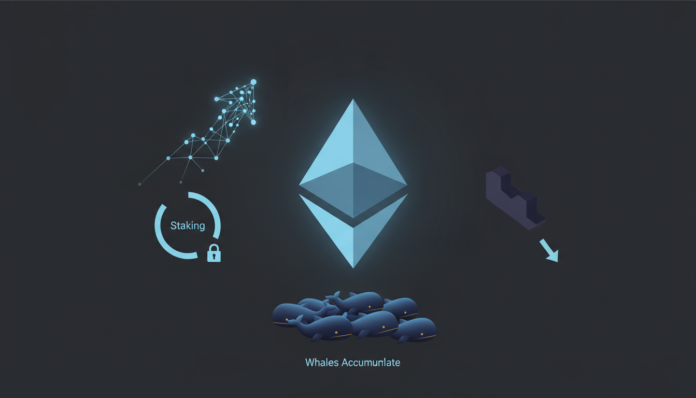
A significant portion of Ethereum’s circulating supply is transitioning from liquid holdings to long-term commitments. Staking participation has doubled since early 2023, now locking over 30% of ETH in validation contracts. Concurrently, exchange reserves have plummeted from over 35 million ETH to approximately 17 million. Data indicates larger investors are accumulating the supply distributed by mid-tier holders, reinforcing structural scarcity despite a current price near $1,900.
Ethereum’s supply is steadily transitioning from liquid ownership to long-term network commitment. Since early 2023, staking participation has climbed from nearly 15% to 30%, progressively relocating ETH into validation contracts.
As the rate crossed 25% in early 2024, deposits continued despite uneven price conditions, indicating motive alignment with yield generation and protocol security. Growth began stabilizing near 29% through 2025 as easily deployable ETH diminished.
In addition to staking, the Liquid Exchange Supply has thinned progressively too, reinforcing the broader supply relocation trend. From nearly 35 to 36 million ETH in 2020, reserves began declining as custody preferences shifted.
By 2023–2024, reserves approached 20–22 million ETH, quantifying how much distribution-ready supply had already exited exchanges. Now, near 16–17 million ETH remains liquid, indicating materially reduced immediate sell pressure.
At the same time, Futures Open Interest climbed towards $37–38 billion as traders increased leveraged exposure. However, when ETH fell below $2,000, long liquidations forced positions to close, pushing the OI down to around $25 billion.
Extending the supply redistribution trend, holder balances rotated progressively across whale tiers. Between 2019 and 2021, 100–1,000 ETH wallets expanded towards nearly 20 million ETH, but balances later declined sharply towards 8–9 million by 2026.
Meanwhile, larger 10,000–100,000 holders accumulated assertively, lifting balances from roughly 15–17 million to above 20 million ETH by 2026. As mid-tier cohorts shed 3–4 million ETH, larger whales absorbed 3–7 million, confirming that sophisticated capital quietly absorbed the circulating supply.
