

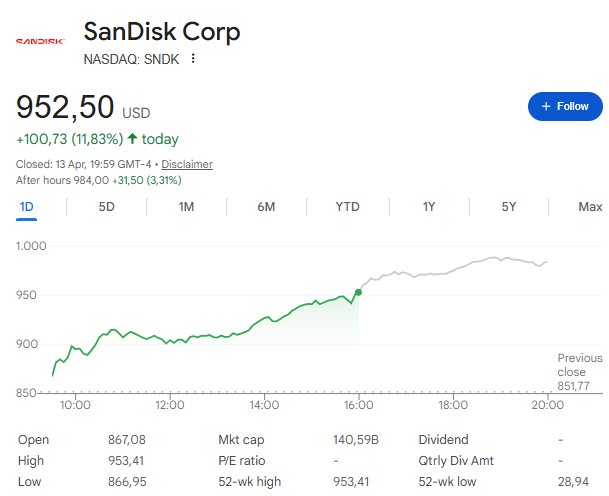
SanDisk Corporation’s stock (SNDK) surged 11.83% to close at $952.50 on Monday, reaching a new 52-week high of $953.41 and lifting its market capitalization to approximately $140.59 billion. The rally was driven by confirmation of the company’s inclusion in the Nasdaq-100 index, replacing Atlassian on April 20, and strong AI-driven demand for NAND storage. Analysts have raised price targets ahead of the company’s upcoming earnings release on April 30.
SanDisk Corp confirmed it will join the Nasdaq-100 on April 20, replacing Atlassian. This announcement propelled SanDisk stock to close at $952.50, up 11.83%, and set a fresh 52-week high of $953.41. Yahoo Finance anchor Josh Lipton stated, “SanDisk will replace Atlassian Corporation. This will go into effect prior to the market open on Monday, April 20th.”
Index-tracking funds must purchase the stock before the effective date, forcing institutional buying. The move also comes amid strong AI-driven demand for NAND storage, fueling a broader rally across memory stocks. Jefferies raised its price target on SNDK to $1,000 citing pricing strength and AI demand.
Citi analyst Asiya Merchant also raised her target to $980, maintaining a Buy rating. SanDisk holds approximately a 13% share of the global NAND market as the only major pure-play NAND company. Its competitors are prioritizing High Bandwidth Memory production, which tightens NAND supply.
The company’s datacenter segment revenue reached $440 million last quarter, growing 76% year-over-year. CFO Luis Visoso commented, “We believe that the NAND market is going through structural evolution catalyzed by AI.” He noted the evolution is pronounced in data centers where data growth is accelerating.
Not all analysts share this bullish outlook. Seeking Alpha contributor David B. McMillan published a Sell rating, placing a base-case fair value at $569 per share. He argues the memory sector remains fundamentally cyclical and investors are pricing SanDisk as a secular growth story. McMillan stated, “Current share price is driven by short-term sentiment and FOMO, not sustainable fundamentals.”
