

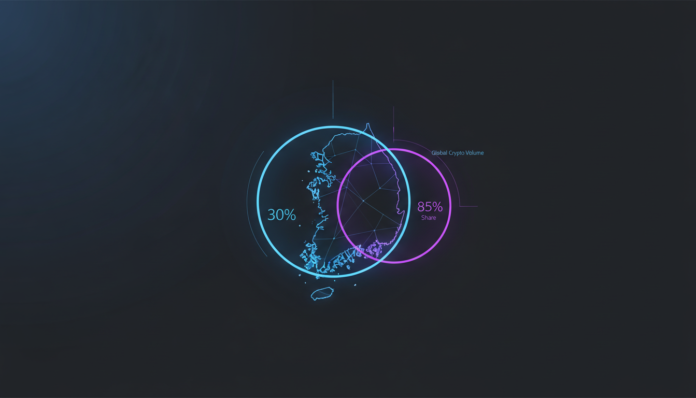
Data from April 2026 reveals South Korea’s outsized role in cryptocurrency markets, accounting for roughly 30% of global trading volume. Weekly trading in the nation averages around $26 billion, with a striking 85% of that activity occurring in altcoins. Major assets like Bitcoin and Ethereum hold comparatively small shares of 9% and 6%, respectively, highlighting a retail-driven market environment distinct from other regions.
Statistics indicate altcoins constitute an incredible 85% of South Korea’s weekly trading volumes, which are approximately $26 billion. The numbers indicate how retail-led demand influences asset choices in the Korean market.
South Korea represents roughly 30% of global cryptocurrency trading activity, making it one of the most influential regional markets. This outsized presence means shifts in Korean market sentiment can have broader implications for global crypto price movements, particularly in altcoins.
Altcoins account for approximately 85% of total trading volume across Korean exchanges, far outweighing major assets. Korea accounts for 30% of global crypto trading volume, with altcoins representing 85% of this activity, Bitcoin just 9%, and Ethereum 6%, as stated by Kaiko Data.
Despite their global dominance, Bitcoin and Ethereum represent a relatively small share of trading activity in South Korea. This distribution underscores a divergence between Korea and other major markets, where Bitcoin and Ethereum typically command a much larger share.
Korean exchanges often operate within a unique liquidity environment, influenced by local regulations, fiat on-ramps, and capital controls. These factors can create pricing inefficiencies and localized premiums sometimes referred to as the “Kimchi premium.”
Compared to South Korea, other Asian markets such as Japan exhibit more balanced trading activity. This contrast highlights how regulatory frameworks and investor demographics shape market behavior across different regions.
