

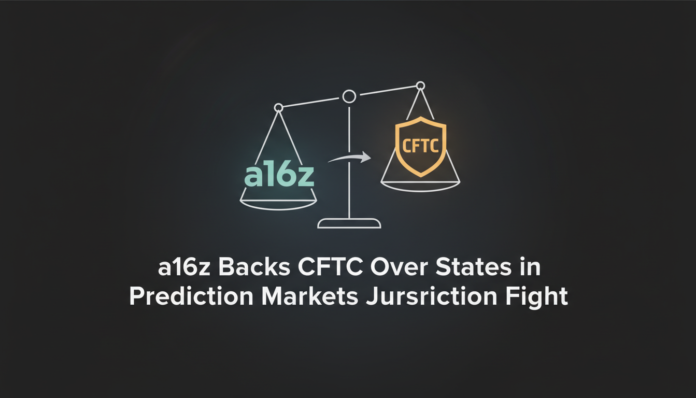
Venture capital firm Andreessen Horowitz (a16z) has formally backed the Commodity Futures Trading Commission (CFTC) in its legal battle against several U.S. states over prediction markets. In a letter submitted Thursday, a16z argued that state-level crackdowns on platforms like Kalshi and Polymarket undermine federal authority and market liquidity. The firm contends the CFTC alone has the power to define what constitutes “gaming” under commodities law.
Venture capital heavyweight Andreessen Horowitz (a16z) has thrown its support behind the Commodity Futures Trading Commission (CFTC) in a growing federal-state regulatory clash over prediction markets. The firm submitted a letter arguing that state attempts to shut down platforms like Kalshi and Polymarket conflict with the CFTC’s mandate.
The letter was filed in response to the CFTC’s advance notice of proposed rulemaking on prediction markets. A16z stated that state-level actions, including cease-and-desist letters and criminal charges, create barriers to impartial market access.
The CFTC has recently filed lawsuits against Illinois, Arizona, Connecticut, New York, and Wisconsin over their regulatory actions. A16z backed the agency’s position, warning that forcing exchanges to block users by state would severely limit liquidity. “Being forced to deny impartial access to users in states that seek to license or prohibit certain event contracts will likely severely circumscribe available liquidity,” the firm wrote.
State attorneys general have labeled these platforms unlicensed gambling operations. A16z countered that the CFTC holds sole federal authority to define “gaming” under commodities law. The firm also advocated for the social value of prediction markets as a tool for price discovery.
A16z expressed support for blockchain-based platforms, claiming onchain auditability improves regulatory oversight. The letter arrives as monthly trading volume on such platforms reportedly reached $25.7 billion in March.
Separately, Polymarket is negotiating with the CFTC to lift a ban on U.S. users imposed in a 2022 settlement. The company paid a $1.4 million penalty and blocked American customers at that time. A full return would require a formal CFTC commission vote.
