

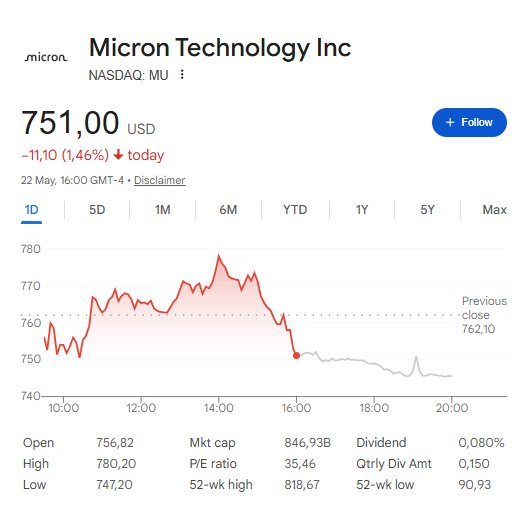
Micron has significantly expanded its DDR4 production capacity at its Manassas, Virginia facility, a move announced after the company commenced its most advanced 1α DRAM production there on May 22. The expansion, fueled by over $2 billion in investment and $275 million in CHIPS Act funding, aims to address a severe shortage in long-lifecycle markets like automotive and industrial, where DDR4 prices have surged. While this increased output raises questions about a potential price correction and its impact on Micron’s stock, the company’s focus on qualified production for specialty sectors and its locked-up HBM4 demand through 2026 presents a counterbalancing narrative for investors.
Micron has initiated a major expansion of DDR4 production at its Manassas, Virginia plant, commencing 1α DRAM manufacturing there for the first time in the U.S. This move quadruples output capacity, reversing previous end-of-lifecycle plans after DDR4 became unexpectedly profitable, with same-spec die prices reportedly 40% higher than DDR5 equivalents according to Nanya Technology.
The $2 billion-plus facility upgrade targets long-lifecycle specialty markets—automotive, defense, aerospace, industrial, and medical—where the DDR4 shortage has been acute. S&P Global Mobility estimated automotive DRAM contract prices could rise 70% to 100% in 2026 versus 2025 levels.
Micron Chairman, President and CEO Sanjay Mehrotra stated, “By bringing advanced 1α DRAM manufacturing to the U.S., we are strengthening domestic supply for our U.S. customers and global markets.” He added that this investment is part of a broader plan to increase the company’s U.S. production share from about 10% today to 40% over the next decade.
Some investors are concerned the new supply could trigger a classic memory cycle price correction, potentially pressuring Micron’s stock. Financial commentator Di Xiang noted that following this capacity news, investors may “shift focus to other segments of the AI supply chain.”
However, the bull case highlights that qualified volume production for DDR4 is not expected until late 2026 and serves insulated specialty markets. Furthermore, Micron has secured all its HBM4 output through 2026 with multi-year contracts, driven by AI infrastructure demand. Executive Vice President Manish Bhatia stated at a conference that “Micron’s HBM4 ramp-up speed is actually twice as fast as last year’s HBM3 12-layer product.”
Wall Street analysts remain overwhelmingly bullish, with 18 buy ratings and zero sells tracked on the stock. The median price target among 28 analysts stands at $542.50, suggesting the DDR4 output surge is currently viewed more as supply security than an imminent oversupply threat.
