

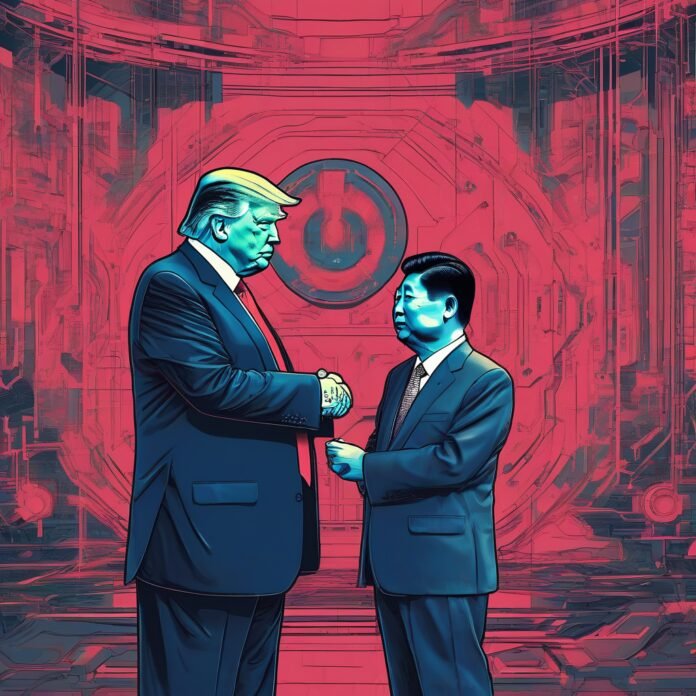
U.S. President Donald Trump and Chinese President Xi Jinping met to discuss artificial intelligence, but produced no sweeping agreement on regulation or restrictions. Trump reiterated his light-touch approach and claimed China agreed to leave rules unchanged. Xi stressed AI must remain under human control. A proposal by Treasury Secretary Scott Bessent for a bilateral AI dialogue with a notification mechanism for security incidents did not result in a formal deal. Export controls on advanced semiconductors were not discussed. Prominent AI industry leaders attended, but symbolism outweighed policy outcomes.
U.S. President Donald Trump and Chinese President Xi Jinping held a summit where artificial intelligence was among the most anticipated topics. Trump was unusually explicit before the meeting and made a triumphant announcement on Friday, calling it “very productive” and promising “tremendous things.”
Trump suggested renaming artificial intelligence to “super intelligence,” claiming Xi approved. He “seemed to like calling the poorly and inaccurately named Artificial Intelligence to a far more accurate and important name, SUPER INTELLIGENCE.”
On regulation, Trump said both countries share the position of leaving rules unchanged. Xi said AI development must remain “under human control,” striking a different tone.
The Trump administration has emphasized speed and competitiveness, while Chinese officials highlight state oversight. Treasury Secretary Scott Bessent proposed a bilateral AI dialogue including a mechanism to notify of significant national security incidents. However, the meeting failed to produce a formal agreement.
Advanced semiconductor export controls were not discussed during preparatory talks, and the summit did not change the current framework. Prominent AI figures such as OpenAI’s Sam Altman, Nvidia’s Jensen Huang, Alphabet’s Sundar Pichai, Elon Musk, and Jeff Bezos attended, underscoring AI’s importance. Symbolism outweighed policy, as the summit did not resolve the fundamental disagreement over how aggressively the technology should be developed, regulated, or constrained.
