

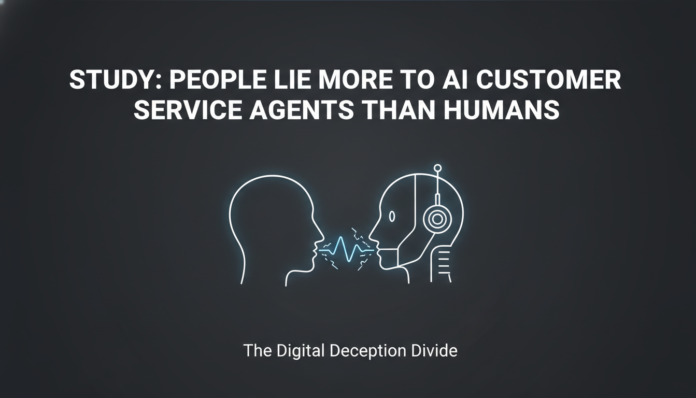
A new study reveals consumers are more likely to act unethically toward AI customer-service agents than human workers. Research published in the Journal of Business Research found people feel less fear of social judgment when interacting with artificial intelligence, leading to increased dishonesty. The effect, termed “anticipatory face loss,” was reduced when AI displayed simulated eye contact or appeared more competent.
Consumers are more willing to lie to a chatbot than a human customer-service worker, according to new research. The study found people feel less social pressure or fear of judgment when interacting with AI systems.
Researchers from Sun Yat-sen University described the effect as “anticipatory face loss,” referring to discomfort from expected embarrassment. “Given the high stakes of consumer unethical behavior toward AI and the theoretical gap regarding social face concerns in human-AI interactions, we propose and test the idea that consumers are more likely to engage in unethical behavior toward AI agents than human ones due to reduced anticipatory face loss,” they wrote.
Participants were more likely to lie, exploit pricing errors, or falsely claim discounts with AI. In one field experiment, they also exaggerated results more often for extra rewards when dealing with AI agents.
The study found social judgment played a larger role than guilt in this unethical behavior. Participants felt less fear of embarrassment because AI systems were viewed as less socially aware and less capable of judging them.
Dishonest behavior decreased when AI agents appeared more competent or used eye gaze cues. This research comes as companies increasingly deploy AI agents for customer support and online transactions.
A March 2025 study by research and advisory firm Gartner said AI agents could autonomously resolve 80% of customer-service issues by 2029. A separate study on humanoid robots found consumers responded more positively to robots with moderate human features like facial expressions.
“When robots are anthropomorphized, consumers tend to evaluate the robot more favorably,” those researchers wrote. “Anthropomorphism drives customer trust, intention to use, comfort, and enjoyment.”
