

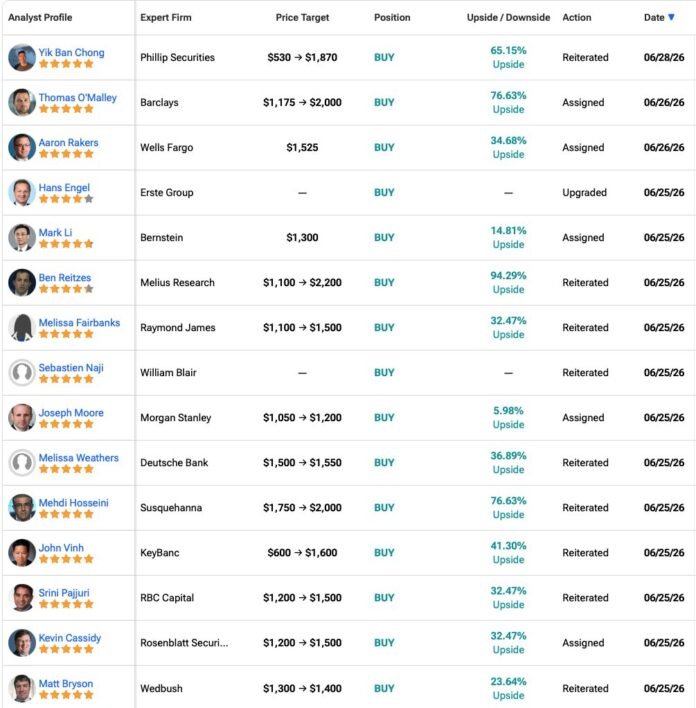
Wall Street analysts are aggressively raising price targets for Micron Technology (MU) stock following a blockbuster quarterly earnings report. Firms including Barclays, Melius Research, and Susquehanna have lifted their targets, with some reaching as high as $2200. The average target now sits at $1557, driven by the company’s critical role in the AI memory chip market. However, analysts also note significant risks, including concerns about an AI bubble and recent legal challenges.
Wall Street analysts are increasingly pushing Micron Technology‘s (MU) stock price target towards $2000. Barclays’ Thomas O’Malley raised the target from $1175 to $2000 days after the company released its quarterly earnings report.
Melius Research raised its price target from $1100 to $2200, while Susquehanna raised their target from $1750 to $2000. The average target currently sits at $1557, which is still higher than MU’s all-time high.
Micron has been a major beneficiary of the ongoing AI boom. The company’s memory chips are essential components for running AI platforms.
The company recently revealed quarterly revenue more than quadrupled year-over-year to $41.46 billion. Earnings per share also came in higher than expected at $25.11, against a projected $21.05.
The report noted that supply-demand conditions for both DRAM and NAND will remain tight beyond calendar year 2027. This performance has fueled the optimistic targets from analysts.
However, there are notable risks surrounding the stock. Prominent trader Michael Burry has compared the current scenario to the late-90s dot-com bubble, and Chinese hedge fund managers have expressed similar concerns about a potential AI bubble.
Micron, along with SK Hynix and Samsung, were recently sued in a US District Court in California for allegedly amping up memory prices. This legal development could pose a challenge to MU’s stock price target.
Further, a re-escalation in the Middle East conflict could lead to oil price surges and supply chain issues. Such events could cause a dip in investor confidence and price corrections for the stock.
