

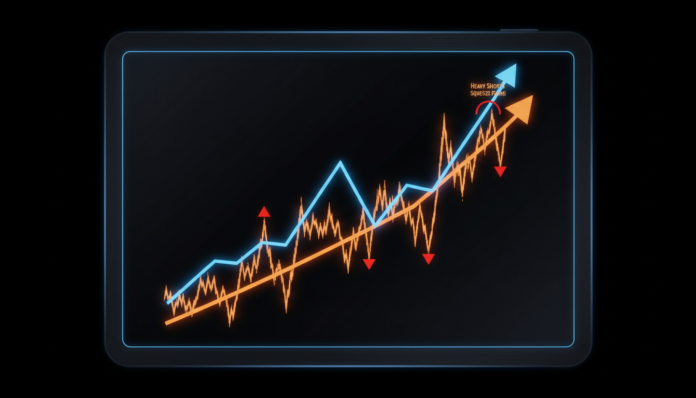
Bitcoin (BTC) is trading in a narrow range, repeatedly testing resistance between $78,000 and $80,000 without a decisive breakout. Market data reveals a significant buildup of short positions, creating conditions for a potential short squeeze despite prevailing bearish sentiment. Analysts note signs that a market bottom may be forming, even as price action remains muted and trading volume stays flat, keeping the cryptocurrency in a state of extended consolidation near the $73,000 support level.
Bitcoin’s price movement continues to lack strong momentum and has not established an actual breakout. The cryptocurrency maintains its current level while facing pressure below key resistance.
The price is forming an ascending triangle pattern, typically a precursor to a breakout, but that move has not yet materialized. An accumulation of short orders continues to increase as shown by derivatives data. The market shows a tendency towards bearish movement according to long/short ratios on multiple exchanges.
Traders are observing the market closely, with most placing bets against its movement. The market tends to reverse direction when most participants anticipate identical results.
Market bottoms often form when traders show extreme negative sentiment or stop trading actively. Bitcoin has achieved this pattern in previous market instances, as stated in the analysis.
Current returns, adjusted for risk via the Sharpe ratio, show weak performance and fail to generate investor interest. This has led to decreased demand for related products and a state of equilibrium.
Bitcoin does not experience a significant decline and maintains a steady price without rapid increases. Trading volume has remained unchanged throughout recent market sessions.
The market danger increases because traders hold their positions for extended periods. The situation introduces potential for a sudden, unbalanced price movement.
A short squeeze occurs when a stock price moves upward from its current level. Short sellers then hurry to close their positions, creating upward market pressure.
